
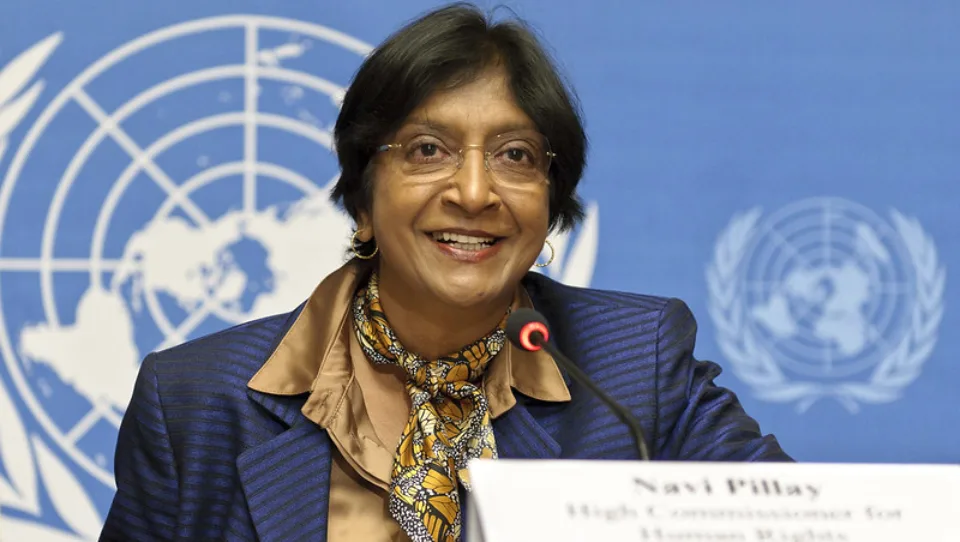
The Norwegian Nobel Committee awarded the 2026 Nobel Peace Prize to Navanethem “Navi” Pillay on Friday, citing her efforts to promote peace and international law. The South African judge was not among the names traders had bid up on Polymarket, where more than $30.7 million had changed hands on the outcome.
Every leading contract on the Nobel Peace Prize Polymarket board settled at zero. Mykola Kuleba, who sat narrowly in front at 23.8%, paid nothing. Yulia Navalnaya at 23.3% paid nothing. Sudan’s Emergency Response Rooms at 17.8% and the International Court of Justice at 6.8% paid nothing. The winner came from outside the board’s visible favorites entirely.
The Nobel Peace Prize Polymarket board in the final minutes before Oslo, with Kuleba at 23.8% and Navalnaya at 23.3%. None of these contracts won. Source: PolymarketEvery Favorite Settled at Zero
Resolution in a market like this is brutal and instant. A name is read aloud at the Norwegian Nobel Institute, and within minutes each contract is worth one or nothing. There is no counting dispute and no appeal.
What makes the result unusual is not that the favorite lost, but that the entire priced field lost. A market can be wrong about which of four names wins and still be broadly calibrated. This one put its money on four outcomes and the committee chose a fifth.
Kalshi, trading the same question, missed it too, with Navalnaya near 19%, Kuleba around 15% and Sudan’s Emergency Response Rooms at 10%. Two deep venues, two different price sets, one shared blind spot.
Investor Takeaway
Every leading contract settled at zero, so this was not a near miss on a close call but a complete failure to price the actual winner, which is the strongest possible version of the result.
The Overnight Spike That Bought Nothing
The twelve hours before Oslo produced a violent move on one name. Navalnaya climbed from roughly 5% to peaks between 65.5% and 69% across October 8 and 9. Journalist Jakub Krupa recorded her at 49% at 7:24 a.m. She then gave almost all of it back, closing near 23%.
No public catalyst explains the run, as there was no leak, no credible report, no shift in the Oslo consensus. The surge and the reversal both happened on sentiment, and both were wrong. Nobel Peace Prize Polymarket traders who bought the top of that move paid up for a contract that expired worthless about three hours later.
Who Navi Pillay Is
Pillay, 85, has spent six decades inside the institutions the committee cited. Born in Durban in 1941 to a Tamil family, she became the first woman to open a law practice in Natal province in 1967, defending anti-apartheid activists, documenting torture and helping win basic rights for prisoners held on Robben Island.
She earned a master’s degree and then a doctorate in law from Harvard, the first South African to do so. Nelson Mandela’s government appointed her an acting judge on the South African High Court in 1995, making her the first non-white woman on that bench. She served eight years on the International Criminal Tribunal for Rwanda, four of them as president, then sat as a judge on the International Criminal Court at The Hague from 2003 to 2008. She was United Nations High Commissioner for Human Rights from 2008 to 2014, and has chaired the UN Commission of Inquiry on the Occupied Palestinian Territory.
The committee sifted 287 nominations this year before settling on her.
Traders Had the Theme and Missed the Person
Here is the detail that should interest anyone who reads prediction markets for signal. The crowd was not far off thematically. The International Court of Justice carried 6.8% on the Nobel Peace Prize Polymarket board, and the International Criminal Court had drawn attention on shortlists. Traders were alive to the possibility that the committee would honor international law.
They bet on institutions. The committee chose a person who had served inside several of them.
That failure mode is structural rather than accidental. The committee’s five members deliberate privately, the shortlist is never published, and nominations stay sealed for 50 years. No participant has order flow from anyone who knows the answer. What fills the vacuum is the annual list from the Peace Research Institute Oslo, which seeded the board with Kuleba, Sudan’s Emergency Response Rooms and the courts. An informed outsider’s guess became the market’s consensus, and the committee ignored it.
FinanceFeeds has tracked this pattern before, when Polymarket priced an Iran blockade that would not end and a liquid market stayed confidently wrong for weeks. The sector has grown into a liquidity venue in its own right rather than a crypto side product, with monthly volumes in the billions across Kalshi and Polymarket, and depth keeps getting mistaken for accuracy.
Donald Trump, who had lobbied publicly and said this week it “would be a great discredit” to the committee if he were passed over, traded near 0.2% and lost like everyone else.
Investor Takeaway
The crowd identified the right theme, international law, but bought institutions rather than individuals, so the useful lesson is about contract construction rather than the committee being unknowable.