
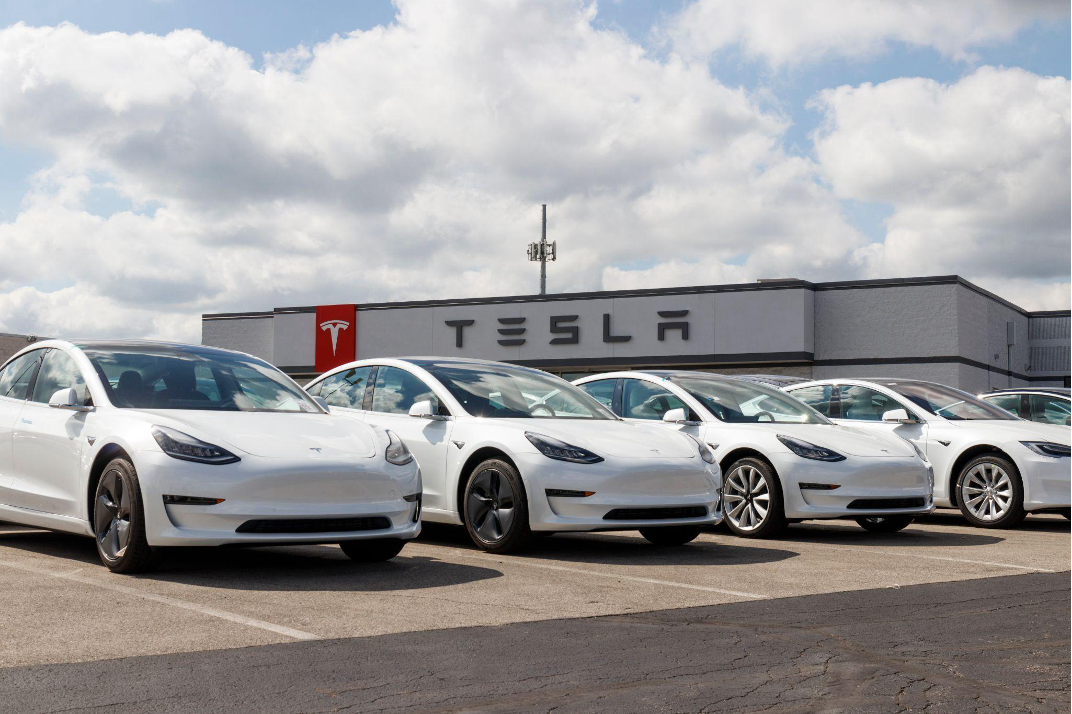
Tesla’s third quarter closes on September 30, and Wall Street cannot agree on how many cars the company sold. The estimates now span a wide 45,000-vehicle gap, from Goldman Sachs at 435,000 to prediction-market traders at roughly 480,000, and the split is not academic, because the same divide appeared before the last report, and the traders won. For a stock down about 17% this year and trading on far more than its delivery count, the Q3 number is the next hard data point in a debate that analysts and betting markets keep answering differently.
Goldman’s Mark Delaney cut his forecast to 435,000 from 490,000, keeping a Neutral rating and a $360 target, while the Visible Alpha consensus sits at 456,000 and a Bloomberg-compiled figure near 466,000. Barclays’ Dan Levy is more bullish at about 475,000, and on Kalshi, the market for Tesla’s Q3 deliveries centers near 480,100, roughly in line with last quarter’s record.
Kalshi traders center Tesla’s Q3 deliveries near 480,000, close to the Q2 record and well above Goldman’s 435,000 call. Source: Kalshi.Why Goldman Cut Its Tesla Forecast to 435,000
Goldman’s reduction rests on monthly sales data across the company’s three largest markets. Delaney wrote that deliveries are “tracking below consensus” in the US, China and Europe, and the domestic figures are the clearest drag, with Tesla selling an estimated 40,816 vehicles in the US in August, down 26% from a year earlier, according to Benzinga. Monthly US volumes in 2026 have settled into a band between roughly 37,500 and 42,400 units, well below the 47,000-unit monthly average the automaker carried through the first half of 2025.
That softening is not confined to the sales charts. The company’s share of the US electric-vehicle market has slipped from about 59% in the fourth quarter of 2025 to around 50.5% by the second quarter of 2026 on Cox Automotive data, as cheaper Chinese rivals and a broader EV field eat into its lead. Goldman’s 435,000 forecast would mark a meaningful sequential drop from the 480,126 vehicles delivered in the second quarter, which is the bear case in a single figure.
Kalshi Nailed Tesla’s Q2 Number While Goldman Missed by 60,000
The reason the prediction-market figure carries weight is Kalshi’s own track record. Before the second-quarter report, Goldman and Kalshi split the same way they have now. Goldman raised its Q2 estimate to 420,000 in mid-June, and the company-compiled analyst consensus stood near 406,000, but hours before the July report, Kalshi’s market gave Tesla a 66% chance of topping 475,000 and a 56% chance of topping 480,000, odds Benzinga captured at the time. Tesla then delivered 480,126, almost exactly where Kalshi’s odds were centered, more than 60,000 above Goldman’s estimate and roughly 74,000 above the broader consensus.
European registrations were running 85% to 90% ahead of a year earlier on the figures Delaney cited in June, helped by Germany’s reinstated EV purchase incentive, an offset to the US weakness the cut leans on. Tesla also added special shifts at its Berlin plant in September, racing to lift weekly Model Y output from fewer than 6,500 units toward 7,500 by mid-October, per coverage of Goldman’s note. Barclays, meanwhile, points to full self-driving adoption above 55% as further support for both volume and margins.
Investor Takeaway
The prediction market has the better recent record, since Kalshi centered on 480,126 for Q2 while Goldman missed by more than 60,000, so a trader consensus near 480,000 deserves at least equal weight to the bank cut.
Why TSLA Already Trades Above Both Analyst Targets
The catch is that TSLA already trades above where the analysts setting these forecasts value it. The stock changed hands near $378 on Monday, up on the day but down about 17% for the year, the worst performer among the Magnificent Seven, and above both Goldman’s $360 and Barclays’ $370 targets. That gap exists because investors increasingly price the company on autonomy and robotics rather than car sales, a tension laid out in the $500 bull versus $250 bear case for the stock.
Tesla stock has swung from a May peak near $446 to a July low and back to about $378, above both Goldman’s and Barclays’ targets. Source: TradingView.A delivery beat near 480,000 would validate the Kalshi read and likely support the shares in the short term, while a miss toward Goldman’s 435,000 would reinforce the demand-erosion narrative and test the premium the stock carries to those targets. The complication is that the market has shown it can shrug off soft deliveries when the robotaxi and AI story stays intact, so the number matters most for how it frames the earnings call rather than as a standalone catalyst.
When Tesla Reports Its Q3 Deliveries
Tesla has not announced the date for its Q3 delivery release, but the timing is predictable. The company typically publishes the raw production and delivery figures in the first days after a quarter closes, and its second-quarter tally arrived on July 2, two days after that quarter ended, so a release in the opening days of October is the reasonable expectation. That report is separate from the Kalshi contract, which resolves on October 21 once the quarter’s delivery data is confirmed.
The delivery number lands into a stretch of catalysts, with the Roadster reveal set for October 1 and the third-quarter earnings call to follow later in the month on a date Tesla has not yet confirmed. For a stock caught between a softening car business and a valuation built on what comes next, the Q3 figure is the first of those events to deliver a hard, verifiable number, and the gap between Goldman and Kalshi is how wide the disagreement has become.
Investor Takeaway
The delivery number is a framing event, not a standalone catalyst, since Tesla trades on autonomy and robotics, so the figure matters most for the narrative it sets into the earnings call.